PREDICT vs CTS5 vs Oncotype Breast Prognosis Tools
Choose the right breast prognosis tool for survival, late recurrence, or genomic recurrence-risk questions.
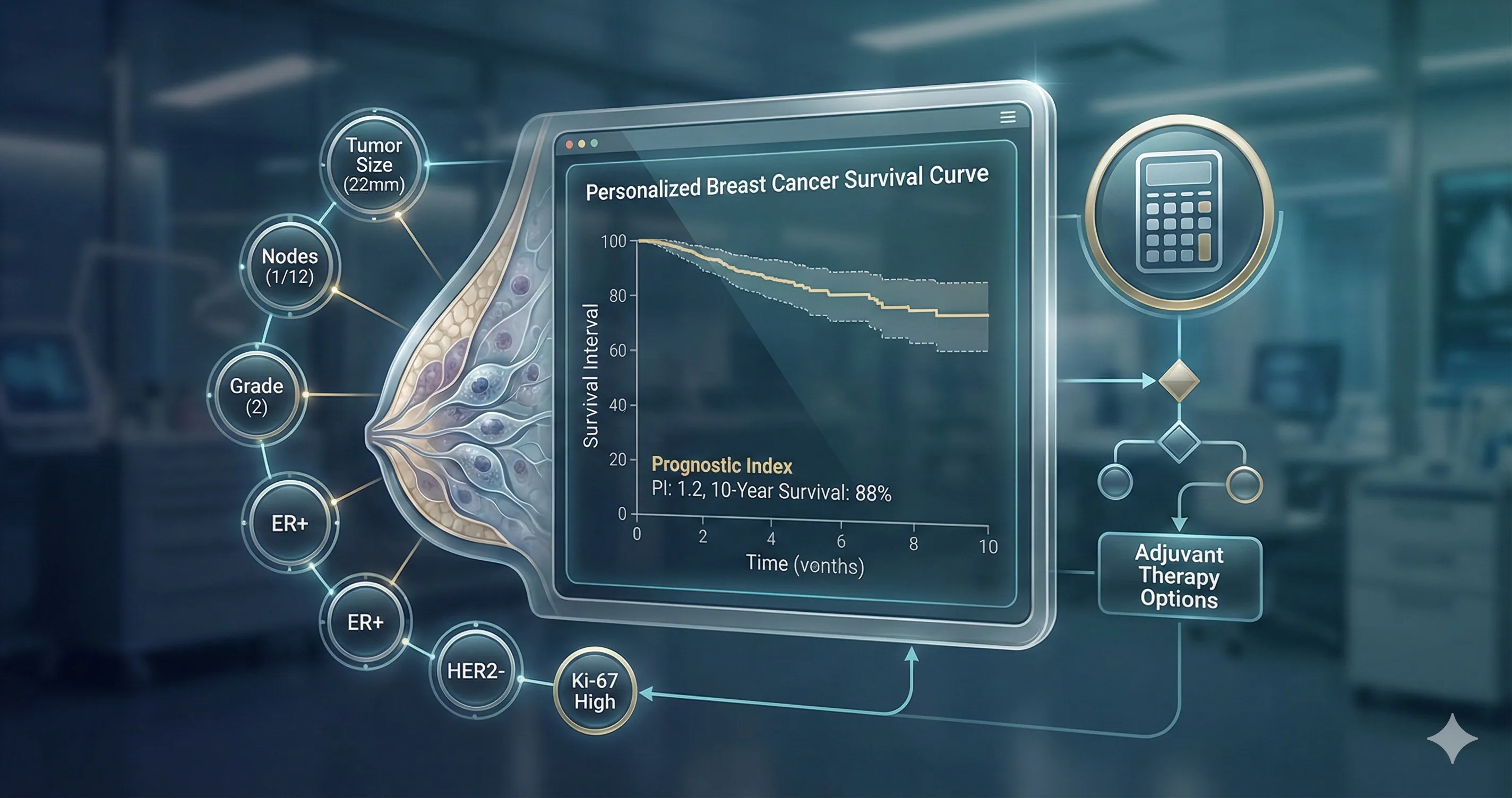
Initial adjuvant discussion
PREDICT Breast
Generate the PREDICT Breast v3.1 population estimate at the official University of Cambridge tool.
Year 5 endocrine decision
CTS5 late recurrence
Estimate 5-10 year distant recurrence risk after 5 years of endocrine therapy.
Genomic recurrence score
Oncotype DX
Interpret a final external score within separate TAILORx or RxPONDER source contexts.
1. Start With the Clinical Question
Breast prognosis tools are easy to confuse because they all use the language of "risk," "recurrence," and "benefit." In practice, they answer different questions at different points in the patient journey.
Use the official PREDICT Breast v3.1 tool for initial adjuvant population estimates, CTS5 for late distant recurrence after five years of endocrine therapy, and the Oncotype DX report interpreter only to identify the matching TAILORx or RxPONDER source stratum for a final external score.
2. PREDICT vs CTS5 vs Oncotype DX vs BCI
| Tool | Use when | Inputs | Output | OncoToolkit link |
|---|---|---|---|---|
| PREDICT Breast | Estimating survival and treatment benefit after surgery for early invasive breast cancer. | Age, tumor size, nodes, grade, ER, HER2, Ki-67, detection mode, and planned treatments depending on version. | Externally recorded official survival and combination-dependent treatment-effect displays. | Official PREDICT |
| CTS5 | ER-positive patients who are distant recurrence-free after 5 years of endocrine therapy. | Age, tumor size, tumor grade, and number of positive lymph nodes. | 5-10 year late distant recurrence risk category. | CTS5 |
| Oncotype DX | Selected HR-positive, HER2-negative early breast cancers where genomic recurrence score may guide chemotherapy decisions. | A 21-gene assay result plus age/menopausal context and nodal status. | Separate TAILORx or RxPONDER source stratum; no unified benefit class. | Oncotype DX report interpreter |
| Breast Cancer Index | Extended endocrine therapy discussions when an ordered genomic assay is available and clinically indicated. | Final report-native YES/NO, reported recurrence percentages, endocrine history, recurrence status, and source context. | Literal external-report interpretation and guideline-scope check; no benefit magnitude or treatment recommendation. | Final BCI report and current assay guidance |
3. Practical Workflow Across the Breast Cancer Timeline
- At initial post-operative planning: generate and interpret the estimate at the official PREDICT Breast tool.
- When chemotherapy benefit is uncertain in HR-positive/HER2-negative disease: consider genomic assays only if the patient matches the validated and guideline-supported population. Interpret the result with age, menopausal status, nodal status, and patient priorities.
- During years 0-5 of endocrine therapy: focus on adherence, toxicity management, ovarian function suppression where indicated, bone health, and recurrence surveillance. Early prognostic tools should not be re-used as if they were dynamic recurrence monitors.
- At the 5-year endocrine therapy decision point: use CTS5 to estimate residual late distant recurrence risk and consider BCI or other genomic information if available and appropriate.
- Before changing treatment: document the exact clinical question, tool version, patient eligibility, and how the estimate influenced shared decision-making.
Clinical caution: A tool that predicts recurrence risk is not automatically a tool that predicts treatment benefit. CTS5 estimates late distant recurrence risk; Oncotype DX is used for chemotherapy-benefit context in selected early HR-positive/HER2-negative disease; BCI is used in some extended endocrine therapy discussions. Keep those endpoints separate.
4. Tool-by-Tool Guidance
4.1 PREDICT Breast: official population-estimate result
PREDICT is an official online model that displays population estimates for women with early invasive breast cancer after surgery. OncoToolkit does not recreate that model: its route records a verified official v3.1 output and preserves the displayed treatment combination.
The recorder is limited to the exact supported v3.1 build. A post-neoadjuvant record requires the documented pretherapy size and carries a warning; metastatic disease, DCIS/LCIS alone, unsupported builds, and uncertain source reports are withheld.
Useful reference: PREDICT Breast official tool guide.
4.2 CTS5: residual late distant recurrence risk
CTS5 was developed as a simple clinicopathologic score for women with ER-positive primary breast cancer who completed 5 years of endocrine therapy and remained free of distant recurrence. It uses age, tumor size, grade, and nodal burden to categorize residual risk over years 5-10.
The key strength is practicality: the inputs are available from routine pathology and clinical records. The key limitation is equally important: CTS5 estimates risk, not endocrine therapy benefit. A high CTS5 score supports a more serious discussion about extended endocrine therapy, but the final decision should also consider prior toxicity, bone health, menopausal status, comorbidities, adherence, patient preference, and genomic information if available.
Useful internal links: CTS5 calculator and CTS5 guide.
4.3 Oncotype DX: source-specific external-report context
Oncotype DX reports a 21-gene Recurrence Score. The TAILORx trial clarified that many node-negative patients with intermediate scores do not benefit from chemotherapy, while younger patients at the higher end of the intermediate range may warrant more nuanced discussion. RxPONDER extended evidence to patients with 1-3 positive nodes and Recurrence Score 0-25, where menopausal status strongly affects interpretation.
Use Oncotype DX only in clinically eligible disease settings. It should not be used to de-escalate therapy in HER2-positive, triple-negative, inflammatory, metastatic, or high-nodal-burden scenarios outside its validated role.
Useful internal links: Oncotype DX report interpreter and Oncotype DX source guide.
4.4 Breast Cancer Index: extended endocrine therapy context
Breast Cancer Index is a genomic assay used in selected HR-positive early breast cancer scenarios. Interpret the final Biotheranostics/Hologic report using its current intended-use information and clinical guidance; OncoToolkit does not reproduce or reinterpret the proprietary assay.
Useful evidence overview: Breast Cancer Index and extended endocrine therapy.
5. Common Pitfalls
Using post-neoadjuvant pathology in PREDICT
Post-treatment tumor size and nodes may not represent the untreated biology that PREDICT expects. Use specialist judgment and appropriate post-neoadjuvant frameworks instead.
Treating CTS5 as a benefit predictor
CTS5 is prognostic for late recurrence. It does not prove that an individual patient will benefit from extended endocrine therapy.
Ignoring menopausal status with Oncotype DX
TAILORx and RxPONDER interpretations differ by age and menopausal status. Do not apply a postmenopausal rule to a premenopausal patient without careful review.
Using one tool to answer every recurrence question
Early recurrence risk, late recurrence risk, survival benefit, and genomic treatment benefit are related but distinct endpoints.
6. Frequently Asked Questions
Should I run PREDICT before ordering Oncotype DX?
The official PREDICT result provides a population-estimate context, while OncoToolkit only records it. It does not replace genomic testing when a validated assay is indicated and does not recommend whether testing or treatment should proceed.
Can a low CTS5 score mean endocrine therapy can stop safely?
A low CTS5 score suggests low estimated late distant recurrence risk, but stopping or extending therapy should still consider prior recurrence risk, side effects, bone health, menopausal status, patient preference, and guideline context.
Does Oncotype DX predict late recurrence after year 5?
Oncotype DX is mainly used to support early adjuvant chemotherapy decisions in eligible HR-positive/HER2-negative disease. Late recurrence and extended endocrine therapy questions may require CTS5, BCI, or other clinicogenomic context.
Related Breast Calculators
Choose the Tool by Endpoint
Survival benefit, chemotherapy benefit, and late recurrence risk are different decisions. Keep the endpoint visible before interpreting the number.
Open Breast Cancer ToolsReferences
- PREDICT Breast v3.1. Official tool and overview. Source
- Dowsett M, et al. Integration of Clinical Variables for the Prediction of Late Distant Recurrence in ER-Positive Breast Cancer: CTS5. J Clin Oncol. 2018;36:1941-1948. Source
- Sparano JA, et al. Adjuvant Chemotherapy Guided by a 21-Gene Expression Assay in Breast Cancer. N Engl J Med. 2018;379:111-121. Source
- National Cancer Institute. TAILORx trial summary. Source
- SWOG. RxPONDER results published in NEJM. Source
- Andre F, et al. Biomarkers for Adjuvant Endocrine and Chemotherapy in Early-Stage Breast Cancer: ASCO Guideline Update. J Clin Oncol. 2022. Source
- Breast Cancer Index and prediction of extended endocrine therapy benefit literature overview. Source