PLCO vs Brock Lung Cancer Risk Calculators
Choose the right lung calculator for screening eligibility, nodule malignancy risk, PET-refined probability, or CT follow-up.
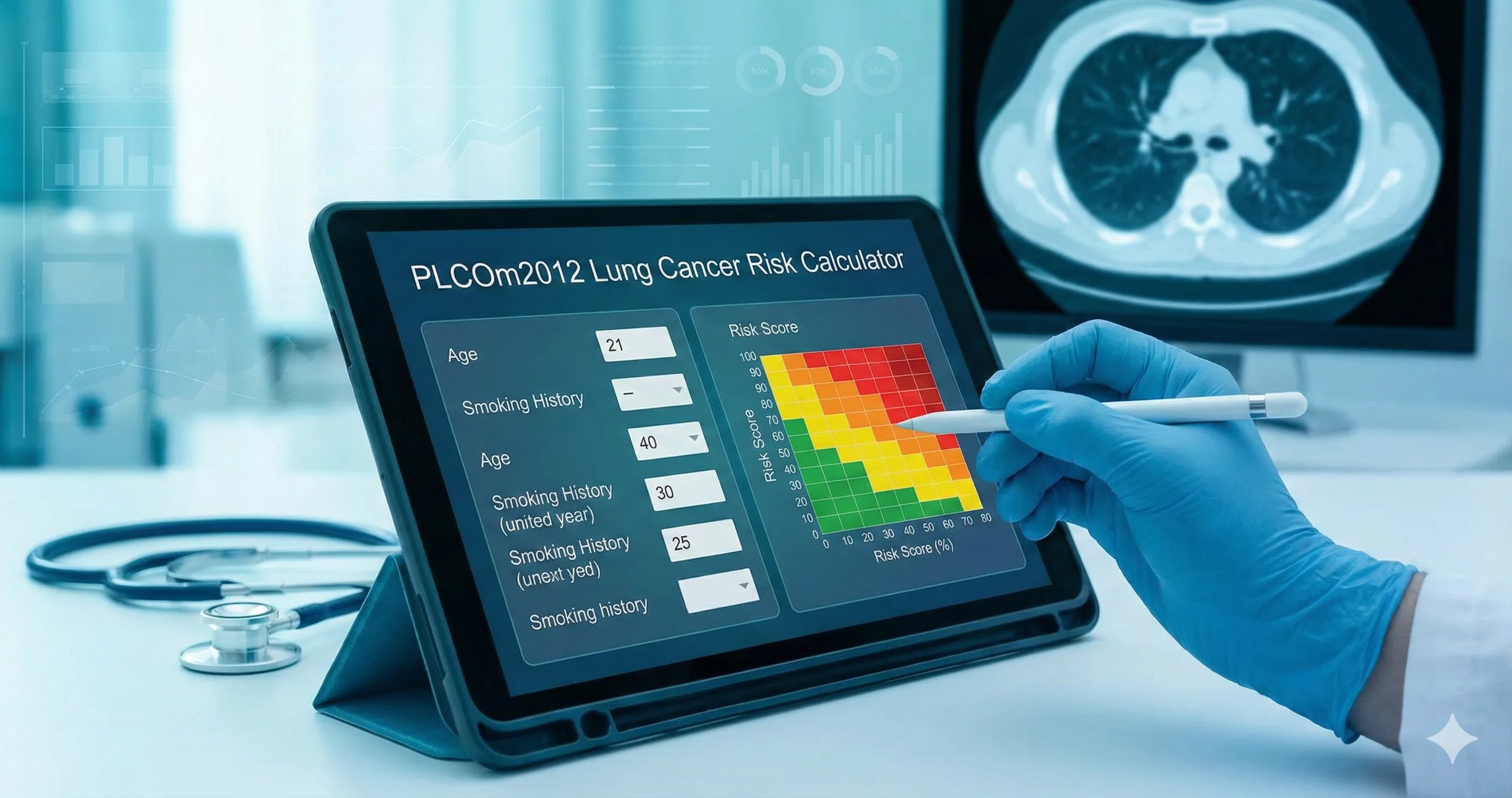
Start before LDCT
Open PLCOm2012 screening risk
Estimate baseline 6-year lung cancer risk, then connect the result to screening eligibility and shared decision-making.
Use the PLCO calculator
Use after CT detects a nodule
Open Brock nodule risk
Move from patient-level screening risk to nodule-level malignancy probability after imaging findings are known.
Use the Brock calculator
Quick Navigation
1. Start With The Clinical Question
Lung cancer risk calculators are often grouped together, but they do not all belong at the same point in the pathway. The safest way to choose between PLCOm2012, Brock, Mayo, Herder, and Lung-RADS is to first ask what information is already available.
The practical split:
- Before screening: use the PLCOm2012 screening workflow to estimate baseline 6-year lung cancer risk and support LDCT eligibility discussions.
- After a nodule is detected: use Brock, Mayo, or Herder depending on the nodule pattern and whether PET data exist.
- For LDCT reporting: use Lung-RADS to standardize category assignment and follow-up recommendations.
This distinction matters because mixing pre-screening risk and post-detection nodule risk can create false reassurance or unnecessary escalation. A patient may have a modest baseline PLCOm2012 risk but still need careful evaluation of a suspicious nodule, and a high PLCOm2012 risk does not make every small nodule malignant.
2. Calculator Comparison Table
| Tool | Best Use | Key Inputs | Output | OncoToolkit |
|---|---|---|---|---|
| PLCOm2012 | Risk-based LDCT screening selection before imaging | Age, smoking history, COPD, BMI, education, race/ethnicity, personal and family cancer history | 6-year lung cancer risk plus screening workflow context | PLCO workflow |
| Brock / PanCan | Pulmonary nodule malignancy probability, especially screening-detected nodules | Nodule size, type, upper-lobe location, spiculation, nodule count, sex, family history, emphysema | Nodule malignancy probability | Brock |
| Mayo Clinic | Solitary pulmonary nodule risk in broader clinical practice | Age, smoking, prior extrathoracic cancer, diameter, spiculation, upper-lobe location | Pretest malignancy probability | Mayo |
| Herder | Refining probability after PET-CT | Mayo probability plus FDG uptake category | Post-PET malignancy probability | Herder |
| Lung-RADS | LDCT screening report standardization and surveillance intervals | Nodule size, attenuation, growth, suspicious features, prior imaging | Reporting category and follow-up pathway | Lung-RADS |
3. PLCOm2012 vs Brock: Different Denominators
PLCOm2012 estimates the chance that an eligible person will develop lung cancer over a 6-year horizon. It was developed from the PLCO trial cohort and is commonly discussed as a more individualized alternative to age-plus-pack-year screening rules. It is useful before LDCT because it incorporates demographic, medical, and smoking variables that fixed thresholds cannot capture.
Brock, also called the PanCan model, starts later in the pathway. It estimates the probability that a specific CT-detected pulmonary nodule is malignant. The nodule is the unit of assessment. That is why nodule morphology, attenuation, size, spiculation, location, and number of nodules become central.
Clinical caution
Do not use PLCOm2012 to decide whether a detected nodule is benign, and do not use Brock to decide whether an asymptomatic patient should enter an LDCT screening program. They answer different questions, even when the same patient eventually needs both.
4. Where Mayo, Herder, And Lung-RADS Fit
Mayo and Brock both estimate pulmonary nodule malignancy probability, but their inputs and original clinical contexts differ. Mayo is often useful for a solitary pulmonary nodule in general clinical practice, while Brock is especially helpful for CT-screening-detected nodules and multiple-nodule contexts. If PET-CT has already been performed, the Herder model can incorporate FDG uptake and move the estimate from pretest probability to post-PET probability.
Lung-RADS is not a malignancy-probability equation in the same sense. It is a reporting and management framework for lung cancer screening CT. In a screening program, Lung-RADS provides the language for radiology categories, while Brock or another probability model may help a multidisciplinary team contextualize risk in selected nodules.
5. Practical Workflow Guidance
- At screening referral: calculate PLCOm2012, check age and smoking history against local screening policy, and confirm that the patient is fit enough and willing to undergo downstream evaluation if cancer is found.
- At LDCT result review: assign or confirm Lung-RADS category, compare with prior imaging, and document whether the finding is new, stable, or growing.
- For an indeterminate nodule: use Brock or Mayo as structured pretest probability support.
- After PET-CT: use Herder if the clinical pathway calls for PET-refined probability estimation.
- At tumor board: combine calculator outputs with surgical fitness, pulmonary reserve, competing diagnoses, patient preference, procedural risk, and local guideline pathways before recommending surveillance, biopsy, ablation, surgery, or systemic work-up.
The OncoToolkit lung cancer hub groups these tools with staging, prognostic, and immunotherapy indices so that screening and nodule workflows are not isolated from the rest of thoracic oncology care.
6. Common Pitfalls
- Using old smoking history data: pack-years, years since quitting, and smoking duration are frequently mis-entered. Reconcile the smoking history before calculating PLCOm2012.
- Ignoring prior imaging: nodule growth and stability can change management even when a one-time probability score looks reassuring.
- Applying nodule models to the wrong lesion type: models may perform differently for subsolid nodules, inflammatory lesions, post-infectious scarring, or known extrapulmonary cancer.
- Treating thresholds as orders: model outputs should trigger structured discussion, not automatic biopsy or discharge from follow-up.
- Forgetting patient-centered feasibility: screening is most useful when the patient could reasonably complete diagnostic evaluation and potentially curative treatment if cancer is detected.
7. Frequently Asked Questions
Should PLCOm2012 or Brock be used first?
Use PLCOm2012 before LDCT screening to estimate baseline lung cancer risk. Use Brock after CT has found a pulmonary nodule and you need a nodule-specific malignancy probability.
Can Brock replace Lung-RADS?
No. Brock estimates malignancy probability for a nodule. Lung-RADS standardizes the screening CT report and follow-up category. They can complement each other, but one does not replace the other.
When should Herder be used?
Use Herder only when PET information is available and the clinical question is how FDG uptake modifies pretest nodule probability.
Related Lung Calculators
Build A Lung Screening Workflow
Start with baseline risk, then move into structured LDCT reporting and nodule probability assessment when imaging findings appear.
Open PLCO Screening WorkflowReferences
- Tammemagi MC, et al. Selection criteria for lung-cancer screening. N Engl J Med. 2013. Source
- McWilliams A, et al. Probability of cancer in pulmonary nodules detected on first screening CT. N Engl J Med. 2013. Source
- Herder GJ, et al. Clinical prediction model to characterize pulmonary nodules: validation and added value of FDG-PET. Chest. 2005. Source
- Gould MK, et al. Evaluation of individuals with pulmonary nodules: ACCP evidence-based clinical practice guideline. Chest. 2013. Source
- ACR Lung-RADS assessment categories. Source
- USPSTF. Screening for lung cancer: US Preventive Services Task Force recommendation statement. JAMA. 2021. Source
- OncoToolkit lung cancer calculator hub. Source