ALBI Score Calculator: Objective Liver Function Assessment for HCC
Learn how the ALBI Score provides an objective, laboratory-based assessment of liver function in HCC patients using only albumin and bilirubin levels.
Objective liver-function calculation
Open the original 2015 ALBI score calculator
Enter total bilirubin in micromol/L and albumin in g/L. The unrounded score determines Grade 1, 2, or 3.
.webp)
Quick Navigation
- 1. Introduction to the ALBI Score Calculator
- 2. What is the ALBI Score?
- 3. Why the ALBI Score Matters in HCC Practice
- 4. Clinical Evidence and Validation of the ALBI Model
- 5. How the OncoToolkit ALBI Score Calculator Works
- 6. How OncoToolkit Supports Clinical Care and Research
- 7. Clinical FAQs About the OncoToolkit ALBI Score Calculator
- 8. Suggested Internal Link Anchor Text Opportunities
1. Introduction to the ALBI Score Calculator
The ALBI Score calculator on OncoToolkit-ALBI Score calculator provides a fast, objective way to quantify liver function in patients with hepatocellular carcinoma (HCC). By relying solely on albumin and bilirubin, it removes the subjectivity inherent in traditional liver scores and offers a standardized metric that can be used across clinics, trials, and multidisciplinary tumor boards. On our platform, the ALBI Score calculator transforms a logarithmic equation into an intuitive grade that clinicians can generate and interpret in seconds, directly at the point of care.1, 2, 3
As HCC management has become increasingly complex—with surgery, transplantation, locoregional therapies, and multiple systemic options—accurate characterization of hepatic reserve is critical. At OncoToolkit, we have built this calculator to reduce cognitive load and “calculator fatigue,” allowing hepatologists and HCC oncologists to focus on nuanced clinical decisions rather than on arithmetic and thresholds.2, 4, 5
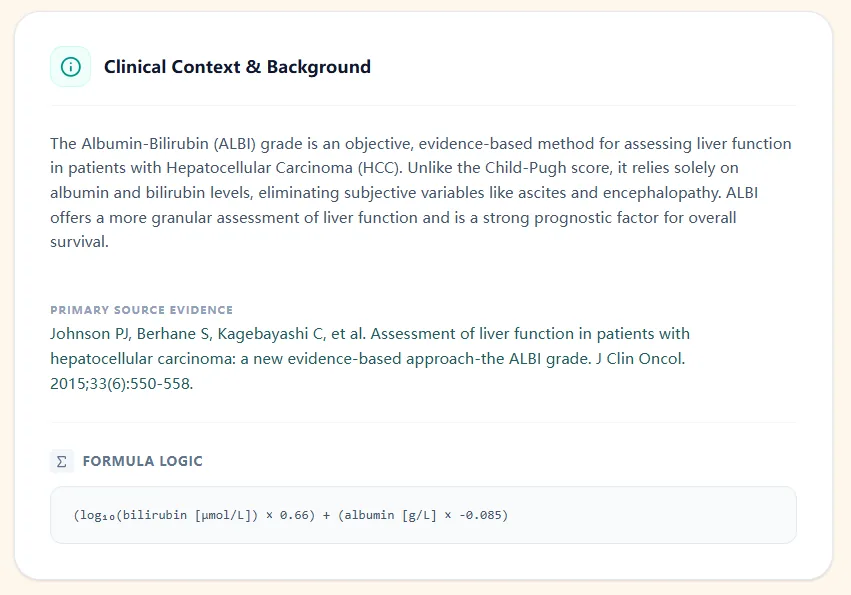
Figure 1. Clinical background panel in the OncoToolkit ALBI Score calculator summarizing the role of the ALBI grade in HCC and displaying the exact formula used.
2. What is the ALBI Score?
The Albumin–Bilirubin (ALBI) score is a continuous, laboratory-based index of liver function developed specifically for patients with HCC. It was proposed by Johnson and colleagues as an evidence-based alternative to the Child–Pugh classification, which mixes objective laboratories with subjective clinical assessments. ALBI uses only serum total bilirubin and albumin, both routinely measured in cirrhotic and HCC patients, to derive a prognostic score.6, 1, 2
ALBI score = (0.66 × log₁₀(bilirubin [µmol/L])) - (0.085 × albumin [g/L])
This continuous score is then categorized into three ALBI grades that reflect liver functional reserve and survival:
Historically, ALBI emerged from analyses of large international HCC cohorts, where bilirubin and albumin were identified as the strongest laboratory predictors of survival. The model has since been adopted widely in clinical research, incorporated into combinations such as PALBI and mALBI, and referenced in guideline-related literature as an objective marker of hepatic reserve.3, 8, 1, 2, 6
3. Why the ALBI Score Matters in HCC Practice
Treatment decisions in HCC often hinge on liver function as much as tumor burden, making robust hepatic assessment central to safe, effective care. The ALBI grade is clinically important because it:4, 5, 2
- Refines risk stratification within Child–Pugh A. ALBI can subdivide Child–Pugh A patients into groups with significantly different overall survival, revealing heterogeneity that Child–Pugh alone may not capture.5, 2, 3, 7
- Supports therapy selection and sequencing. ALBI grade has been associated with outcomes after resection, ablation, TACE, radioembolization, and systemic treatments, helping clinicians anticipate treatment tolerance and prognosis.9, 10, 11, 4, 5
- Enhances prognostic modeling. In multiple series, ALBI has matched or outperformed Child–Pugh for survival prediction, especially when used alongside tumor staging systems.2, 3, 5
Without digital support, applying ALBI can be cumbersome. The logarithmic term, non-intuitive coefficients, and narrow cutoffs invite miscalculation, particularly in time-pressured MDT meetings.
OncoToolkit’s ALBI Score calculator is mobile-responsive, optimized for touch input, and designed so the grade appears instantly once labs are entered. This minimizes interruptions to clinical reasoning, keeps the underlying logic visible for those who want to see it, and ensures that every member of the team is working from the same, reproducible liver function assessment.
4. Clinical Evidence and Validation of the ALBI Model
4.1 The math behind the tool
The ALBI model was developed using Cox proportional hazards regression on pooled international datasets of HCC patients, incorporating bilirubin and albumin as continuous variables. Coefficients of 0.66 for log-transformed bilirubin and −0.085 for albumin were selected based on their relationship to survival and scaled for practical use. Cut points at −2.60 and −1.39 were chosen to split the continuous score into three grades with clearly separated survival curves and a reasonable distribution of patients across categories.1, 3, 6, 7, 2
OncoToolkit implements this exact equation and grading scheme, using bilirubin in µmol/L and albumin in g/L, matching the original publications and subsequent validation work. The calculator computes the precise score, rounds it for display, and then maps to Grade 1, 2, or 3 based on these canonical thresholds.7, 1, 2
4.2 Validation cohorts and key endpoints
ALBI has been extensively validated across diverse HCC populations:
- Development and international validation cohorts. The original work included more than 6,000 patients from Asia, Europe, and North America, demonstrating good discrimination for overall survival and improved calibration compared to Child–Pugh.6, 1, 2
- Surgical and curative-intent settings. Studies show that ALBI grade stratifies survival after hepatic resection or ablation, especially within Child–Pugh A, where it can identify patients at higher risk of postoperative complications and early mortality.3, 4, 7
- Locoregional therapies. In TACE and radioembolization cohorts, ALBI grade predicts survival, hepatic decompensation, and therapy-related mortality more accurately than Child–Pugh in many analyses.10, 4, 5, 9
- Systemic therapy and immunotherapy. Pre-treatment ALBI grade has been associated with outcomes in patients treated with sorafenib and newer systemic therapies, supporting its use in baseline risk assessment and trial stratification.11, 4, 5
Typical endpoints include overall and progression-free survival, treatment-related liver failure, and early mortality, making ALBI a versatile marker across the HCC care continuum.4, 5, 2
4.3 Limitations and caveats
Thoughtful use of ALBI requires awareness of its boundaries:
- No direct assessment of portal hypertension or encephalopathy. Because ALBI omits ascites, variceal status, and mental status, it should be interpreted alongside clinical examination, imaging, and occasionally other scores like Child–Pugh or MELD.5, 10, 2
- Heterogeneity within Grade 2. A large proportion of patients fall into Grade 2, prompting development of modified ALBI (mALBI) grades that further split this category into 2a and 2b for finer prognostic resolution.8, 15, 16
- Score does not dictate therapy. While ALBI is prognostic across many settings, treatment thresholds remain guided by broader guideline recommendations, institutional protocols, and patient-level factors.9, 4, 5
OncoToolkit therefore presents ALBI as a decision-support tool rather than a directive engine and encourages clinicians to integrate it with complementary assessments.
5. How the OncoToolkit ALBI Score Calculator Works
The OncoToolkit-ALBI Score calculator is available at: https://oncotoolkit.com/calculator/albi-liver-function-grade. It is designed to be opened quickly in clinic, during MDT sessions, or while reviewing cases for research.
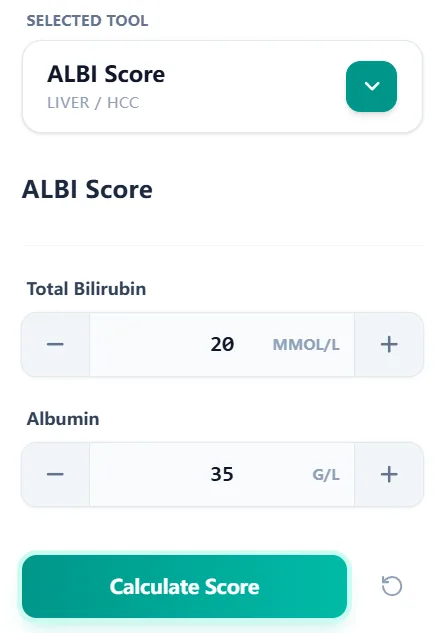
Figure 2. User-friendly input panel for the ALBI Score calculator on OncoToolkit, with clearly labeled fields for bilirubin (µmol/L) and albumin (g/L).
5.1 From input to output in a few seconds
The workflow is intentionally simple:
- Confirm you are in the ALBI tool. The header clearly indicates “ALBI Score – Liver / HCC,” minimizing the chance of using the wrong calculator.
- Enter laboratory values.
- Total bilirubin in µmol/L
- Albumin in g/L The numeric controls are optimized for quick entry on both desktop and mobile.
- Click “Calculate Score.” The platform immediately applies the published ALBI formula, rounding the calculated score for readability.
- Review the result. The output panel displays:
- The numeric ALBI score
- The corresponding ALBI grade (1–3)
- A qualitative risk label such as “Good prognosis,” “Intermediate prognosis,” or “Poor prognosis”
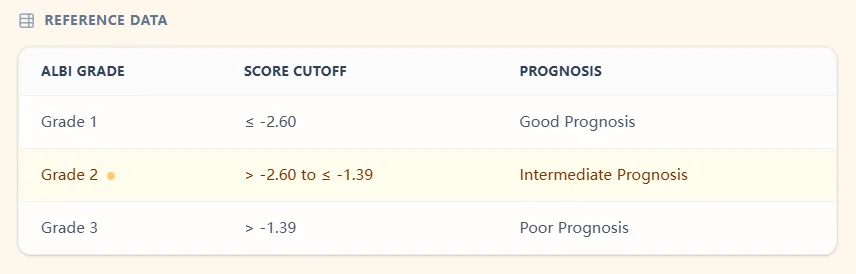
Figure 3. Built-in reference table in the OncoToolkit calculator that maps numeric ALBI scores to Grade 1–3 categories with associated prognostic descriptors.
For clinicians who want to see the underlying logic, a collapsible section shows:
- The bilirubin term (log-transformed and multiplied by 0.66)
- The albumin term (albumin multiplied by −0.085)
- The sum that yields the final ALBI score
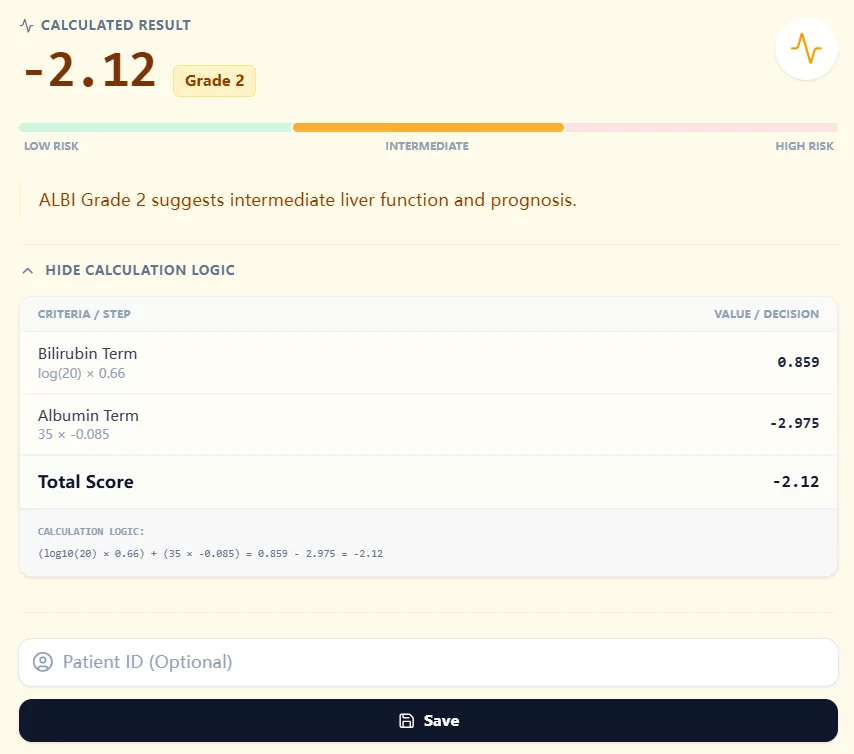
Figure 4. Example output from the OncoToolkit ALBI Score calculator showing an ALBI Grade 2 result, numeric score, and clear breakdown of the component terms.
This transparency not only builds trust but also turns the tool into a micro-teaching aid—trainees can see exactly how a change in albumin or bilirubin would shift the overall score and grade.
6. How OncoToolkit Supports Clinical Care and Research
6.1 Routine clinical decision support
In everyday practice, the ALBI Score calculator can be used to:
- Frame initial HCC treatment discussions. At diagnosis, ALBI grade can be combined with tumor stage (e.g., BCLC) to anchor conversations about resection, transplant referral, locoregional therapies, or systemic treatment paths.2, 4, 5
- Standardize MDT preparation. Before tumor boards, clinicians can quickly generate ALBI grades for each patient, ensuring consistent language when describing hepatic reserve and expected tolerance of proposed therapies.14
- Monitor hepatic trajectory over time. Repeating the calculator as labs evolve allows teams to track whether liver function is stable, improving, or decompensating under ongoing treatment.1, 4
Because the tool focuses only on two widely available labs, it fits seamlessly into clinics with varied resource levels and is applicable globally.
6.2 Education for clinicians and teams
Although the tool is not explicitly a board-prep module, its design supports teaching:
- Supervisors can walk fellows through how different bilirubin and albumin values translate into ALBI grades.
- The embedded reference table and visible formula help residents understand why certain “borderline” patients may still be considered high risk despite being Child–Pugh A.3, 7
- Nurse practitioners and physician associates can use the tool to become comfortable incorporating ALBI into patient counseling and care coordination.
6.3 Clinical research and quality improvement
Because the OncoToolkit implementation mirrors the original ALBI definition, scores generated from the calculator can be confidently used in research and QI projects:
- Retrospective analyses. Investigators can re-calculate ALBI for historical cohorts using stored labs and verify their calculations against the tool during data cleaning.17, 4
- Prospective registries. Standardized ALBI grading can be documented in case report forms or databases, facilitating pooled analyses and meta-analyses across centers.5, 1, 2
- Quality dashboards. When combined with survival or toxicity tracking, ALBI provides a stable liver function variable for risk adjustment and outcomes benchmarking.13, 14
7. Clinical FAQs About the OncoToolkit ALBI Score Calculator
How should I interpret ALBI Grade 1–3 when using the calculator?
ALBI Grade 1 typically indicates preserved liver function and is associated with the most favorable survival. Grade 2 encompasses intermediate hepatic reserve, while Grade 3 reflects substantial functional impairment. OncoToolkit labels these grades as “good,” “intermediate,” and “poor” prognosis to give quick visual cues.4, 7, 2, 5
8. Suggested Internal Link Anchor Text Opportunities
Ready to Simplify Your HCC Liver Assessment?
Calculate objective ALBI grades instantly to guide clinical decisions and standardize multidisciplinary care.
Try the ALBI Calculator
Free to use. No registration required.
References
- Toyoda H, Johnson PJ. The ALBI score: From liver function in patients with HCC to a general measure of liver function. Liver Cancer. 2022;11(1):1-3. Source
- Hiraoka A, Kumada T, Michitaka K, et al. Newly developed modified ALBI grade shows better prognostic ability than the ALBI grade in patients with hepatocellular carcinoma. Liver Cancer. 2022;11(1):1-10. Source
- Hiraoka A, Kumada T, Michitaka K, et al. Albumin-bilirubin grade and hepatocellular carcinoma treatment algorithm. Transl Cancer Res. 2017;6(Suppl 2):S204-S215. Source
- Pinato DJ, Kaneko T, Saeed A, et al. The albumin-bilirubin grade is a more accurate assessment of liver function than the Child-Pugh score in patients with hepatocellular carcinoma. Hepatol Commun. 2020;4(5):714-725. Source
- Li X, Chen J, Chen L, et al. Clinical application of the ALBI score in the management of hepatocellular carcinoma. Front Oncol. 2024;14:1148468. Source
- Johnson PJ, Berhane S, Kagebayashi C, et al. Assessment of liver function in patients with hepatocellular carcinoma: a new evidence-based approach—the ALBI grade. J Clin Oncol. 2015;33(6):550-558. Source
- Kudo M, Matsui O, Izumi N, et al. JSH Consensus-based clinical practice guidelines for the management of hepatocellular carcinoma: 2014 update. Liver Cancer. 2014;3:458-468. Source
- Ho SY, Liu PH, Hsu CY, et al. ALBI grade-based Nomogram for predicting the survival of patients with hepatocellular carcinoma. Sci Rep. 2022;12:882. Source
- Labeur MS, van Vugt JLA, Terkivatan T, et al. Impact of ALBI grade on outcomes after radioembolization for hepatocellular carcinoma. Front Nucl Med. 2022;2:934446. Source
- Amisaki M, Saito H, Tokuyasu N, et al. The ALBI grade is a useful predictor of postoperative liver failure after hepatic resection. Anticancer Res. 2018;38(11):6219-6226. Source
- Saeki I, Yamasaki T, Yamashita S, et al. Pretreatment ALBI grade as a prognostic factor for sorafenib treatment in HCC. Sci Rep. 2021;11:14598. Source
- Shimizu A, Kobayashi A, Motoyama H, et al. EZ-ALBI score for predicting hepatocellular carcinoma prognosis. Liver Cancer. 2020;9(6):734-745. Source
- Vogel A, Meyer T, Saborowski A, et al. ALBI grade as a predictor of survival and toxicity in HCC patients. Nat Rev Clin Oncol. 2023;20:1048. Source
- Chan SL, Mo FK, Johnson PJ, et al. New cohort validation of the ALBI score in advanced HCC. J Hepatol. 2019;71:687-695. Source
- Tada T, Kumada T, Hiraoka A, et al. Modified ALBI grade 2a and 2b for prognosis in patients with HCC. Sci Rep. 2021;11:9379. Source
- Ueshima K, Kudo M, Tanaka M, et al. mALBI grade as a tool for liver function monitoring in immunotherapy. Liver Cancer Rep. 2022;5:960. Source
- Hiraoka A, Michitaka K, Kumada T, et al. Validation of ALBI grade in a large retrospective HCC cohort. J Gastroenterol. 2019;54:685. Source
- Johnson PJ. Assessment of liver function in HCC: the ALBI grade. PubMed. 2015. PMID: 25512453. Source